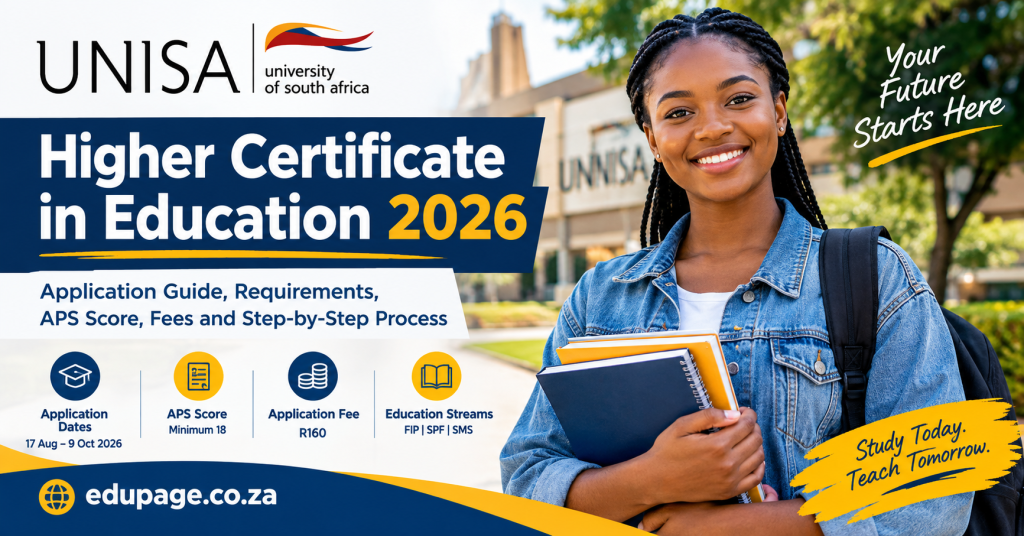
Unisa Higher Certificate in Education 2026: What Applicants Need to Know
Prospective education students who want to study through the University of South Africa (Unisa) have an important application window to watch in 2026.
Unisa’s current undergraduate application period for the 2027 academic year runs from 17 August to 9 October 2026. This includes applicants interested in the university’s Higher Certificate in Education streams.
The Higher Certificate in Education can be an access route for students who want to develop foundational academic and teaching-related skills before progressing to further undergraduate study. Unisa describes the qualification as providing access to candidates who may otherwise not meet newer minimum entry requirements for certain qualifications.
However, prospective students should understand an important distinction:
The Higher Certificate in Education is not itself a professional teaching qualification.
Unisa explicitly states this on its qualification information page.
This guide explains what the qualification is, who can apply, the current APS requirement, how the online application works and what happens after submitting an application.
When Does the Unisa Higher Certificate in Education Application Open?
For the 2027 academic year, Unisa’s undergraduate application period is:
Opening date: 17 August 2026
Closing date: 9 October 2026
Useful Links:
Unisa states that undergraduate applications must be submitted online during the prescribed application period.
This makes 2026 the important application year for students hoping to start the qualification in 2027.
Applicants should not wait until the final day.
An application may involve selecting a qualification, providing personal information, uploading supporting documents and paying the applicable application fee.
What Is the Unisa Higher Certificate in Education?
The Higher Certificate in Education is an NQF Level 5 qualification carrying 120 credits.
Unisa currently lists the qualification under different education streams, including:
- Foundation Phase and Intermediate Phase (FIP)
- Senior Phase and Further Education and Training Teaching (SPF)
- Senior Phase Mathematics and Science Education (SMS)
The FIP and SPF qualification pages currently show qualification code 90093, NQF Level 5, 120 credits, SAQA ID 101813, an APS/AS of 18, and a maximum completion period of three years.
The purpose is not simply to provide another certificate.
Unisa says the programme is intended to help develop competencies such as:
- Basic language and learning skills.
- Information-management skills.
- Teaching skills.
- Selected subject knowledge.
- Skills needed for studying through an Open Distance Learning environment.
Which Higher Certificate in Education Stream Should You Choose?
This is an important decision because applicants should consider their intended education pathway rather than choosing a programme simply because it appears easier to enter.
Foundation Phase and Intermediate Phase
The FIP stream is aimed at students interested in the Foundation Phase and Intermediate Phase education pathway.
Unisa lists it as:
Higher Certificate in Education – Foundation Phase and Intermediate Phase
Qualification code: 90093-FIP
NQF level: 5
Credits: 120
APS/AS: 18
Senior Phase and Further Education and Training Teaching
The SPF stream is designed around the Senior Phase and Further Education and Training teaching pathway.
Unisa lists it as:
Higher Certificate in Education – Senior Phase and Further Education and Training Teaching
Qualification code: 90093-SPF
NQF level: 5
Credits: 120
APS/AS: 18
Senior Phase Mathematics and Science Education
Unisa also lists a Senior Phase Mathematics and Science Education stream.
Students considering this route should carefully examine the current qualification page and its specific subject requirements before submitting an application.
Who Can Apply for the Higher Certificate in Education?
The exact requirements should always be checked against the particular Unisa qualification page.
For the currently published HCE information, Unisa lists the following admission routes for the FIP and SPF streams.
National Senior Certificate
Applicants can qualify with an NSC with at least 40% in the language of teaching and learning.
Senior Certificate
Applicants with a Senior Certificate may qualify with:
- At least an E symbol on Higher Grade, or
- A D symbol on Standard Grade
in the language of teaching and learning.
National Certificate (Vocational)
Applicants with an NC(V) NQF Level 4 can qualify with an equivalent of at least 40% in the language of teaching and learning in terms of the NSC.
What APS Score Do You Need?
The currently published Unisa information lists an APS/AS of 18 for the Higher Certificate in Education streams shown above.
But applicants should not make the mistake of thinking:
APS 18 = automatic admission.
That is not how Unisa’s selection process works.
Unisa states that admission depends on meeting the qualification requirements and whether space is available. It also specifically says that admission is not automatic even when applicants meet the minimum requirements.
How Does Unisa Calculate APS?
Unisa says its APS calculation uses the NSC 1-to-7 achievement scale.
The calculation is based on six recognised 20-credit subjects, while Life Orientation is excluded because it is a 10-credit subject.
The current scale is:
| Achievement | APS |
|---|---|
| 80–100% | 7 |
| 70–79% | 6 |
| 60–69% | 5 |
| 50–59% | 4 |
| 40–49% | 3 |
| 30–39% | 2 |
| 0–29% | 1 |
The maximum APS using this system is 42.
Step-by-Step: How to Apply for the Unisa Higher Certificate in Education
Step 1: Check the Qualification Before Applying
Before opening the application form, visit Unisa’s official qualification information.
Check:
- Qualification name.
- Stream.
- Qualification code.
- APS.
- Language requirements.
- Other admission requirements.
- Application dates.
- Application fee.
This step is particularly important because qualification requirements can change.
Step 2: Choose Your Education Stream
Think about the pathway you ultimately want to follow.
For example, if your long-term goal is Foundation Phase education, investigate the FIP stream.
If you are interested in Senior Phase and FET teaching, examine the SPF route.
Do not choose randomly.
The purpose of an access qualification is to help you move towards a suitable future academic pathway.
Step 3: Prepare Your Supporting Documents
Applicants should prepare their supporting documentation before starting the application.
Depending on your circumstances, documents may include:
- Identity documentation.
- School-leaving certificate.
- National Senior Certificate.
- Senior Certificate.
- NC(V) documentation.
- Academic records where applicable.
- Other supporting documentation requested by Unisa.
Previously registered Unisa students should pay particular attention to academic-record requirements. Unisa says students who studied previously through Unisa should obtain their academic record through myUnisa and submit it as part of the application process.
Step 4: Apply Online
Unisa states that undergraduate applications must be submitted online.
For the 2027 academic year, the undergraduate application window runs from 17 August to 9 October 2026.
Applicants should use Unisa’s official application platform rather than relying on unofficial application links shared on social media.
Official Unisa application information:
Unisa Apply for Admission
Step 5: Choose Your Qualifications Carefully
Unisa currently allows an applicant to apply for a maximum of three qualifications during the application process.
The university says applicants cannot add or change a qualification after submitting their application, except in exceptional circumstances where a written request may be considered.
This means applicants should think carefully before clicking submit.
A useful strategy is to rank your choices according to your actual career and study plans.
Step 6: Receive Your Unisa Student Number
Once you have completed the relevant application process, Unisa provides a student number where applicable.
The student number is important because it is used when paying the application fee.
Do not confuse a student number with confirmation of admission.
Receiving a student number does not mean that you have been accepted into the qualification.
Step 7: Pay the Application Fee
For the 2027 undergraduate application cycle, Unisa lists the online application fee as:
R160
The university says applicants should pay the fee after receiving their student number.
The fee is non-refundable, including if:
- You decide not to study through Unisa.
- You do not meet the admission requirements.
- You cannot be offered a place because spaces are limited.
Only first-time Unisa applicants are required to pay the application fee; applicants who have previously paid an application fee at Unisa do not need to pay it again, according to the university’s current FAQ.
Step 8: Upload Your Supporting Documents
Your application is not something you should leave incomplete after filling in the online form.
Unisa says an application will not be processed for first-time applicants until the application fee has been paid and supporting documents have been uploaded.
Applicants should therefore check their application carefully before the closing date.
Unisa also states that it will not accept late applications or supporting documents after the application closing date.
For the 2027 cycle, that deadline is 9 October 2026.
Step 9: Keep Proof of Your Application
After applying, save:
- Your student number.
- Application confirmation.
- Proof of payment.
- Copies of submitted documents.
- Application reference information.
- Screenshots where appropriate.
This creates a record that you can use when tracking your application.
Step 10: Track Your Application
Submitting an application does not mean that the process is finished.
Unisa assesses applications and considers factors including:
- Academic admission requirements.
- Minimum points score.
- Number of spaces available.
The university specifically says that the first-come, first-served principle does not apply.
This is an important correction to a common misconception among applicants.
Applying on the first day does not automatically guarantee admission.
What Happens After You Apply?
Applicants should expect the university’s assessment process to take time.
Unisa currently says applicants will receive feedback four to six weeks after the closing date for applications.
For the 2027 cycle, this means applicants should not panic if they do not receive an immediate outcome after submitting an application.
Continue monitoring your application through the official Unisa channels.
What If Your Application Is Successful?
If you receive an offer, you must follow Unisa’s instructions carefully.
For first-time applicants, Unisa says a First-Year Experience MOOC must be completed before the applicant can accept the offer and register for semester 1 of the 2027 academic year.
Applicants should also note that an offer has a limited acceptance period.
Unisa states that applicants have 10 working days from the date of the offer to accept or decline it. If the offer is not accepted within that period, it may be withdrawn.
Can You Apply for More Than One Qualification?
Yes.
Unisa currently allows a maximum of three qualification choices during the application process.
However, applicants should use this opportunity strategically.
For someone interested in education, it can make sense to consider qualifications that align with their long-term career plans rather than selecting three unrelated programmes simply to increase the number of applications.
Does Meeting the APS Guarantee Admission?
No.
This is one of the most important facts prospective students should understand.
Unisa explicitly states that meeting the academic requirements does not automatically result in acceptance.
Admission depends on:
- Meeting the qualification requirements.
- Meeting the minimum points score.
- Available spaces.
The university says students are accommodated based on the number of spaces available for each qualification.
Is the Higher Certificate in Education a Teaching Qualification?
No.
Unisa explicitly states:
The Higher Certificate in Education is not a Professional Teaching Qualification.
This distinction matters.
Someone completing the Higher Certificate should not automatically describe themselves as a qualified professional teacher.
Instead, the qualification can provide foundational learning and an access pathway towards further study.
Students should investigate the relevant Bachelor of Education or other qualification requirements if their ultimate goal is professional teaching.
Can the Higher Certificate Lead to Further Study?
The qualification is designed to provide access and foundational competencies and can offer articulation into certain undergraduate qualifications.
Unisa describes the purpose of the qualification as providing students with foundational skills and some articulation into first-year undergraduate degree/diploma qualifications.
However, students should never assume that completing the certificate guarantees admission to a particular future qualification.
Always check the admission requirements for the next qualification separately.
How Long Do You Have to Complete It?
The currently listed FIP and SPF Higher Certificate in Education streams show a maximum completion period of three years.
The qualification carries 120 credits at NQF Level 5.
Students should check the current curriculum and registration information before planning their study workload because Unisa notes that curriculum information may be updated for future academic years.
Is Unisa Suitable for Students Who Cannot Attend a Traditional Campus Every Day?
Unisa operates through an Open Distance e-Learning (ODeL) model.
That can make distance study attractive to people who have employment, family responsibilities or live far from a traditional university campus.
However, distance learning still requires discipline.
Students should expect to manage:
- Reading.
- Assignments.
- Online activities.
- Deadlines.
- Examinations.
- Communication with the university.
- Independent study.
Being an online/distance student does not mean that the qualification is automatically easier.
Financial Planning Before Starting Your Studies
One area prospective students sometimes overlook is the total cost of studying.
The R160 application fee is only the application fee. It should not be confused with the total cost of completing a qualification.
Students may also need to budget for:
- Registration fees.
- Tuition fees.
- Prescribed books.
- Data.
- Internet access.
- Transport where necessary.
- Study materials.
- Other university-related costs.
Unisa maintains separate information about student fees and study materials, and prospective students should check the latest published costs rather than relying on old social-media posts.
A practical budgeting tip
Before accepting an offer, create a simple study budget.
For example:
| Expense | Monthly estimate |
|---|---|
| Data/internet | R300 |
| Transport | R600 |
| Study materials | R300 |
| Other study costs | R300 |
| Example total | R1,500 |
These figures are only an illustration and are not Unisa’s official fees.
The purpose is to demonstrate why students should budget for the full cost of distance learning.
Can NSFAS Help With Unisa?
Students who need financial assistance should investigate the current NSFAS rules directly.
Unisa’s application FAQ directs applicants to NSFAS for information about funding.
Because funding rules, application windows and eligibility can change, prospective students should not assume that a qualification is funded simply because it is offered by Unisa.
Common Mistakes to Avoid
Mistake 1: Applying After the Deadline
For the current 2027 cycle, the undergraduate application deadline is 9 October 2026.
Unisa states that late applications and supporting documents will not be accepted after the closing date.
Mistake 2: Choosing the Wrong Qualification
Applicants sometimes choose a programme because they have heard that it has a lower APS.
Think about the qualification you ultimately want.
Mistake 3: Assuming APS 18 Guarantees Admission
It does not.
Available spaces also matter.
Mistake 4: Forgetting the Application Fee
For first-time applicants, the current online application fee is R160.
An unpaid application may not be processed.
Mistake 5: Uploading Documents Too Late
Do not wait until the final hours before the deadline.
Mistake 6: Confusing an HCE With a Professional Teaching Qualification
The Higher Certificate is not itself a professional teaching qualification.
Mistake 7: Using Unofficial Application Links
Always start with Unisa’s official website.
A Better Application Strategy for 2026
Instead of simply rushing to submit an application, applicants can use a four-stage approach.
Stage 1: Confirm eligibility
Check your school results against the qualification requirements.
Stage 2: Confirm your pathway
Choose the education stream that fits your intended future studies.
Stage 3: Prepare everything
Have your documents, email address, contact details and payment arrangements ready.
Stage 4: Submit and monitor
Apply before the deadline, save your confirmation and monitor the official application status.
This approach reduces avoidable mistakes.
Unisa Higher Certificate in Education 2026 Application Checklist
Before pressing submit, check:
☐ I have selected the correct education stream.
☐ I meet the published admission requirements.
☐ My APS/AS meets the stated minimum where applicable.
☐ My supporting documents are ready.
☐ I have checked the application deadline.
☐ I understand the R160 application fee.
☐ I have received/recorded my student number where applicable.
☐ I have paid the application fee if required.
☐ I have uploaded my supporting documents.
☐ I saved proof of submission.
☐ I understand that meeting the minimum requirements does not guarantee admission.
☐ I know that the HCE is not itself a professional teaching qualification.
Frequently Asked Questions
When is the Unisa Higher Certificate in Education application deadline?
For undergraduate applications for the 2027 academic year, Unisa lists 9 October 2026 as the closing date. The application period opened on 17 August 2026.
How much is the Unisa application fee?
The current online undergraduate application fee is R160. The fee is non-refundable.
What APS do I need for the Higher Certificate in Education?
The currently published FIP and SPF qualification pages list an APS/AS of 18.
Does APS 18 guarantee admission?
No. Unisa says admission also depends on available spaces and compliance with the qualification requirements.
Is the Higher Certificate in Education a teaching qualification?
No. Unisa explicitly says that it is not a Professional Teaching Qualification.
Can I apply for three qualifications?
Yes. Unisa currently allows applicants to apply for up to three qualifications, but you should choose them carefully because qualifications cannot normally be changed after submission.
When will I receive an application outcome?
Unisa currently says applicants will receive feedback four to six weeks after the application closing date.
What happens if I receive an offer?
First-time applicants must complete the First-Year Experience MOOC before accepting the offer and registering for semester 1 of 2027. Unisa says offers must be accepted within 10 working days.
Can I submit documents after the deadline?
No. Unisa says late applications and supporting documents will not be accepted after the closing date.
Final Takeaway
The Unisa Higher Certificate in Education can provide an important academic access route for prospective education students, but applicants should understand exactly what the qualification does — and what it does not do.
For the 2027 academic year, applications are open from 17 August to 9 October 2026. The currently listed HCE streams include Foundation Phase and Intermediate Phase and Senior Phase/FET Teaching, with the published qualification information showing NQF Level 5, 120 credits and an APS/AS of 18 for these streams.
The current online application fee is R160, and the fee is non-refundable.
Most importantly, applicants should not assume that meeting the minimum APS guarantees a place. Unisa considers available capacity as part of its admission process.
If your long-term goal is to become a professional teacher, treat the Higher Certificate as a possible pathway into further study, rather than as the final teaching qualification.
Official application source
Sources and References
- Unisa — Higher Certificate in Education: Senior Phase and FET Teaching (90093-SPF) — qualification purpose, credits, NQF level, APS, admission requirements, application dates and fees.
- Unisa — Higher Certificate in Education: Foundation Phase and Intermediate Phase (90093-FIP) — qualification information and admission requirements.
- Unisa — Apply for Admission — 2027 undergraduate application dates.
- Unisa — Undergraduate Application FAQs — APS calculation, application fee, qualification choices, admission decisions and offer acceptance.
- Unisa — Study Materials Information — guidance on prescribed books and additional study materials.
Editorial and transparency note
This article was updated using Unisa’s official information available in September 2026. Application dates, fees, admission requirements, qualification structures, funding rules and available spaces can change. Applicants should therefore verify the information on Unisa’s official website immediately before submitting an application.
This article is intended for general educational and career information. It does not guarantee admission, registration, funding or completion of a teaching qualification.