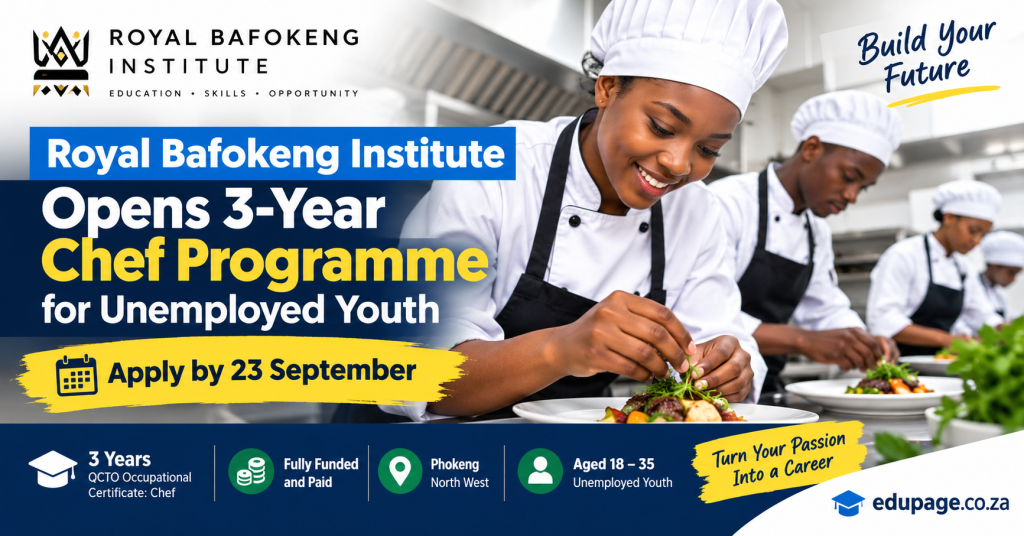
Royal Bafokeng Institute Opens 3-Year Chef Programme
Young South Africans interested in turning their passion for cooking into a professional career have a new opportunity through the Royal Bafokeng Institute (RBI).
RBI is recruiting candidates for a three-year QCTO Occupational Certificate: Chef programme, combining theoretical learning, practical kitchen training and workplace experience in the hospitality industry.
The latest recruitment information confirms that applications opened on 2 September 2026 and close on 23 September 2026. This is particularly important for applicants who may have seen an earlier RBI Chef advertisement with an August closing date. The newer September recruitment notice should be treated as the current opportunity.
The programme is based in Phokeng, North West, where RBI operates post-school and technical vocational education programmes. The institute says its post-school programmes are focused on developing practical skills that can contribute to financial independence.
Royal Bafokeng Institute Chef Programme at a glance
| Detail | Information |
|---|---|
| Institution | Royal Bafokeng Institute |
| Programme | QCTO Occupational Certificate: Chef |
| Duration | 3 years |
| Location | Phokeng, North West |
| Target group | Unemployed youth |
| Age | 18–35 years |
| Minimum qualification | Grade 12 with Mathematics Literacy |
| Funding | Advertised as fully funded |
| Payment | Advertised as paid |
| Application period | 2–23 September 2026 |
| Closing date | 23 September 2026 |
RBI’s recruitment information describes the opportunity as fully funded and paid, but the available advert does not state a specific monthly stipend amount. Applicants should therefore avoid relying on unofficial stipend figures circulating on social media.
What is the RBI Chef Programme?
The programme leads to the QCTO Occupational Certificate: Chef.
Unlike a short cooking course, the programme is structured around a combination of:
- Theoretical learning
- Practical training
- Workplace experience
The purpose is to develop the skills required to work as a professional chef within the Hotels, Restaurants and Catering (HORECA) environment.
RBI describes the chef occupation as involving the planning, organisation and execution of food preparation, cooking, finishing, presentation, holding and storage in hospitality establishments.
Useful Links:
This practical structure is important for applicants because professional cookery involves considerably more than preparing food.
Students need to understand food safety, kitchen operations, preparation techniques, presentation, storage and the standards expected in commercial hospitality environments.
Who can apply?
According to RBI’s recruitment information, applicants must meet the following conditions:
- Be a South African citizen
- Be between 18 and 35 years old
- Be unemployed
- Have Grade 12 with Mathematics Literacy
- Not currently participate in another programme funded by government or another public institution
RBI also states that candidates with disabilities are encouraged to apply, with proof of disability required where applicable.
Meeting the minimum requirements does not automatically guarantee selection. Shortlisted candidates are expected to go through the institute’s selection process.
What documents should applicants prepare?
Applicants should prepare a complete application before submitting it.
The earlier RBI recruitment information identifies documents including:
- Curriculum vitae
- Certified copy of ID
- Latest academic results or Matric certificate
The newer September recruitment notice also indicates additional supporting documentation may be required, including items such as:
- Parents’ certified IDs
- Kgosana/Kgotla recommendation letter
- Parent payslip or unemployment affidavit
- Motivation letter
Because the September recruitment process supersedes the earlier August advertisement, applicants should use the latest application form and document checklist supplied by RBI rather than relying on an old social-media post.
When does the application close?
The latest RBI recruitment information gives the closing date as:
23 September 2026
Applications opened on 2 September 2026.
This gives eligible candidates a limited period to obtain the application form, prepare their documents and submit their applications.
The closing date is especially important because an earlier RBI Chef advertisement circulated with a 24 August 2026 deadline. That earlier opportunity should not be confused with the current September recruitment.
Where is the programme located?
The programme is associated with Royal Bafokeng Institute in Phokeng, North West.
RBI’s official website lists its address as Sun City Road (R565), Salema, Phokeng 0335, South Africa and identifies post-school programmes as one of its focus areas.
Applicants should consider the location before applying, particularly because a three-year programme requires a substantial commitment.
Is the Chef Programme really fully funded?
RBI’s recruitment material describes the Chef programme as fully funded and paid.
However, there is an important distinction between saying that a programme is fully funded and knowing exactly what every financial benefit includes.
The currently available recruitment information does not provide a specific stipend amount.
Applicants should therefore confirm directly with RBI:
- What expenses are covered
- Whether a monthly allowance is paid
- The amount of any payment
- Whether accommodation is provided
- Whether transport is covered
- What workplace-related expenses are included
This approach is safer than publishing an unverified stipend amount.
RBI has historically offered SETA-funded learnership and apprenticeship training, with its skills-development material noting that such opportunities can include a stipend.
Why the three-year duration matters
Some job seekers may initially assume that a Chef programme is simply a short culinary course.
This opportunity is different.
The three-year structure allows participants to develop occupational competence through a combination of learning and practical experience.
RBI’s hospitality material has previously described its training approach as involving learning, practice and workplace experience, with hospitality programmes covering areas such as professional cookery, food and beverage services and front-office services.
For someone who wants a long-term hospitality career, this can be more valuable than completing a short introductory cooking course.
What careers can a Chef qualification support?
Professional cookery can lead to opportunities across the hospitality and catering sector.
Potential work environments include:
- Hotels
- Restaurants
- Catering companies
- Resorts
- Lodges
- Conference venues
- Institutional kitchens
- Food-service businesses
The qualification can also provide a foundation for people who eventually want to operate their own food business.
However, applicants should understand that training does not guarantee employment.
The purpose of the programme is to build occupational skills and workplace competence. Employment after completion depends on factors including performance, available vacancies, experience, employer requirements and the individual’s career development.
Why hospitality skills remain relevant
Hospitality is a broad industry that includes much more than restaurants.
South Africa’s tourism economy supports demand across accommodation, food services, events and related businesses.
For young people who enjoy practical work and interacting with customers, hospitality can offer several potential career paths.
A chef qualification can also provide transferable workplace skills such as:
- Time management
- Teamwork
- Food safety
- Customer awareness
- Organisation
- Cost control
- Problem-solving
- Working under pressure
These skills can be valuable beyond the kitchen.
What makes this opportunity different from a normal cooking course?
There are several important differences.
Occupational focus
The programme is designed around a recognised occupation rather than simply teaching recreational cooking.
Workplace exposure
The programme includes workplace elements, giving learners an opportunity to connect their training with real hospitality environments.
Three-year commitment
Applicants need to be prepared for a substantial training period rather than expecting a few weeks of instruction.
QCTO qualification
The programme is presented as an Occupational Certificate: Chef under the QCTO occupational training framework.
Financial support
RBI describes the current programme as fully funded and paid, although the specific financial terms should be confirmed directly with the institute.
How to apply for the RBI Chef Programme
Applicants should obtain the latest application form and follow the September 2026 recruitment instructions.
RBI’s latest recruitment notice says application forms are available through the RBI website and at the institute’s offices in Phokeng. Applications should be submitted with the required documentation at the RBI offices before the closing date.
Before submitting, check that:
- You meet the age requirement.
- You are unemployed.
- You have Grade 12 with Mathematics Literacy.
- You are a South African citizen.
- You are not participating in another government-funded programme.
- Your documents are correctly certified where required.
- You have completed the latest application form.
- You submit before 23 September 2026.
Royal Bafokeng Institute official website
Important: Shortlisted applicants will undergo testing
Applicants should be aware of another condition contained in RBI’s recruitment information.
The earlier Chef programme advertisement stated that shortlisted candidates would undergo compulsory drug and toxicology testing and that drug testing would be a regular requirement during the programme.
Applicants should therefore read the latest recruitment documentation carefully and understand the conditions attached to selection and participation.
How to make your application stronger
Meeting the minimum requirements is only the starting point.
A well-prepared application can help you present yourself professionally.
Keep your CV simple
Your CV should clearly show your education, contact details, skills and any relevant experience.
Experience does not necessarily have to be formal employment. School activities, volunteering, community projects or informal food-related experience may help demonstrate your interests and abilities where relevant.
Explain your motivation
If a motivation letter is required, explain why you want to become a chef and what you hope to achieve through the programme.
Avoid generic statements such as “I need a job.”
Instead, demonstrate genuine interest in hospitality and explain how the opportunity fits your career plans.
Submit complete documents
Missing documents can create unnecessary problems during the selection process.
Use a checklist before submitting your application.
Beware of fake Chef Programme advertisements
Popular training opportunities often attract unofficial advertisements and scams.
Applicants should be cautious if someone asks for money to:
- Secure a place
- Guarantee selection
- Speed up an application
- Arrange an interview
- Provide a “special” application link
The safest approach is to verify information through Royal Bafokeng Institute’s official website and official contact channels.
Do not assume that an advertisement is genuine simply because it uses RBI’s name or logo.
A useful opportunity for young people interested in hospitality
The RBI Chef Programme is particularly relevant for unemployed young people who want a practical career rather than a purely academic qualification.
The combination of theory, practical training and workplace experience gives applicants an opportunity to develop skills in a real occupational environment.
The three-year commitment should not be underestimated, however.
Anyone applying should be prepared to dedicate significant time to training and should understand the programme’s funding, attendance, assessment and workplace requirements before accepting a place.
Frequently Asked Questions
Is the Royal Bafokeng Institute Chef Programme fully funded?
RBI describes the 2026 Chef programme as fully funded and paid. However, the available recruitment information does not state a specific stipend amount, so applicants should confirm the financial terms directly with RBI.
How long is the Chef Programme?
The programme runs for three years and leads to the QCTO Occupational Certificate: Chef.
What qualification is required?
The published requirement is Grade 12 with Mathematics Literacy. Applicants must also satisfy the other eligibility conditions.
Who can apply?
The programme is aimed at unemployed South African citizens aged 18 to 35, subject to the full eligibility requirements.
Where is the programme based?
The opportunity is associated with RBI in Phokeng, North West.
When is the current application deadline?
The latest recruitment notice gives 23 September 2026 as the closing date.
Is the stipend amount confirmed?
No specific amount is stated in the recruitment information reviewed for this article. Applicants should not rely on unofficial figures.
Final word
The Royal Bafokeng Institute Chef Programme 2026 offers unemployed young South Africans a practical route into professional cookery and the wider hospitality industry.
The three-year programme leads to the QCTO Occupational Certificate: Chef and combines theoretical learning, practical training and workplace exposure.
The latest recruitment information gives applicants until 23 September 2026 to apply.
For anyone considering the opportunity, the priority should be to verify the latest application form, prepare the required documents and submit before the deadline.
Most importantly, applicants should remember that “fully funded and paid” does not mean that every possible cost is necessarily covered, and the current advert does not publish a specific stipend amount. Confirm the financial arrangements directly with RBI before making decisions based on expected payments.
Sources and references
This article was independently researched using Royal Bafokeng Institute’s official website and current recruitment information, supplemented by institutional and recruitment listings used to cross-check the programme details. RBI’s official website confirms its post-school and technical vocational education focus, while current RBI recruitment information confirms the Chef programme, eligibility requirements and September 2026 application period.
Editorial transparency: EduPage does not recruit candidates, administer the RBI programme or guarantee selection. Programme requirements, funding arrangements, application procedures and closing dates can change. Readers should verify the latest information directly with Royal Bafokeng Institute before submitting personal documents.
Last verified: 8 September 2026.