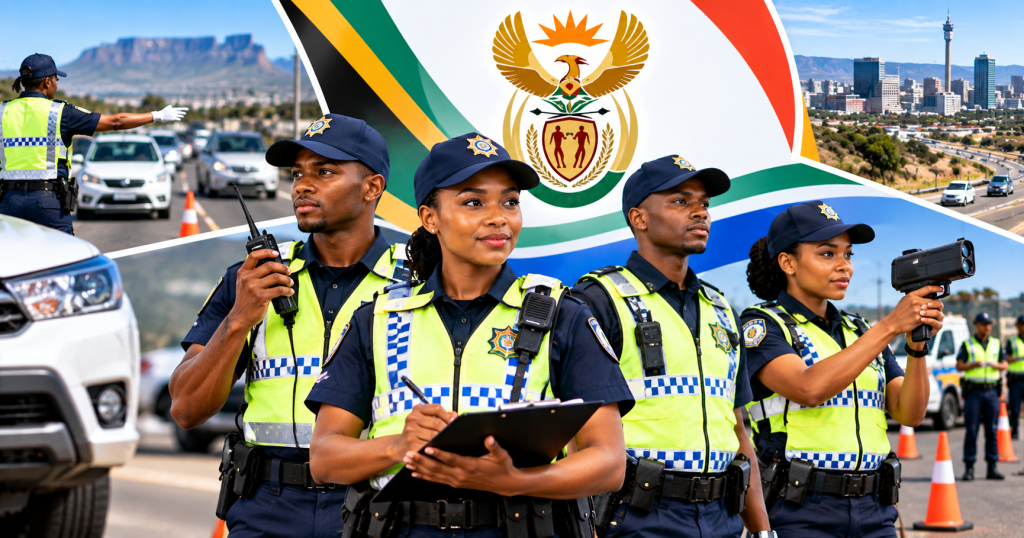
Basic Traffic Officers Diploma Learnership 2026: Latest Application Information
Are you looking for a government training opportunity that could lead to a career in law enforcement and road safety? The Basic Traffic Officers Diploma Learnership 2026 is a popular search topic for South Africans interested in becoming traffic officers.
Traffic officers help keep public roads safe by enforcing traffic legislation, managing traffic operations and supporting road safety initiatives. However, before applying, candidates need to understand the official entry requirements, how recruitment works and whether a particular vacancy is still open.
The South African Qualifications Authority (SAQA) lists the Occupational Diploma: Traffic Officer, qualification ID 121688, at NQF Level 6. The qualification is registered from 30 January 2024 to 30 January 2029. It is designed to prepare learners to work as traffic officers and covers the knowledge, practical skills and workplace experience required for the occupation. Official SAQA qualification record
Application status: The official sources reviewed for this article do not establish a currently open, nationwide recruitment intake under the exact title “Basic Traffic Officers Diploma Learnership 2026.” A specific 2026 Traffic Learner recruitment round in Limpopo has closed. Applicants should check the latest notices from their provincial transport department, municipality and the Road Traffic Management Corporation (RTMC) before submitting an application.
What is the Traffic Officer Diploma Learnership?
Traffic officer training is a structured route towards gaining the skills and knowledge needed for traffic law enforcement. The registered qualification is not the same thing as a vacancy announcement: a qualification can remain registered even when an employer is not recruiting new trainees.
SAQA explains that the Occupational Diploma: Traffic Officer prepares learners to direct, control and coordinate traffic operations, promote safe road use and apply relevant road traffic legislation. The qualification includes knowledge, practical skills and work-experience components.
The qualification is restricted to approved traffic training centres. SAQA states that prospective learners are typically selected by government authorities responsible for road traffic law enforcement, while the RTMC explains that applicants generally need to be employed or appointed as trainees by an authorised authority.
This means candidates should be careful when they see adverts claiming that anyone can simply register online and receive a traffic officer diploma. Confirm the training provider’s approval and the recruitment process before paying any fees or sharing personal information.
Basic Traffic Officer requirements for 2026
The RTMC publishes general entry requirements for traffic officer training. Individual employers may set additional conditions, so always read the complete vacancy advert.
Useful Links:
Typical requirements include:
- Education: Grade 12 (Matric) or an equivalent qualification.
- Driving licence: A valid Code B licence for a manual-transmission vehicle.
- Criminal record: Applicants must meet the applicable criminal-record requirements.
- Medical fitness: A medical certificate may be required as proof that the applicant can undertake strenuous exercise.
- Age: The RTMC’s general guidance states that applicants should not be older than 35.
- Appointment: Applicants generally need to be employed or appointed as trainees by a provincial authority, local authority or government agency.
Official reference: RTMC — Training Norms and Standards
Some vacancies may specify further conditions involving physical fitness, medical assessments, residency, documentation or other eligibility criteria. The conditions in the current official advert take priority over general summaries shared on social media.
Can applicants without Matric apply?
The RTMC lists Grade 12 or an equivalent qualification as a general minimum requirement for traffic officer training. Applicants without Matric should therefore not assume they qualify for the standard traffic officer training pathway.
If you do not meet the educational requirements, consider checking official entry-level vacancies or other recognised training programmes whose advertised criteria match your current qualifications. Do not pay an agent who promises to bypass the official requirements.
Documents to prepare before applying
Preparing your documents in advance can make it easier to submit a complete application when a suitable vacancy opens.
Depending on the employer’s requirements, you may need:
- An updated CV with your current contact details.
- A certified copy of your South African ID, if requested.
- A copy of your Matric certificate or accepted equivalent.
- Proof of your valid manual Code B driving licence.
- Medical documentation, if required at the application stage.
- Proof of residence or other supporting documents specified in the advert.
- The employer’s completed application form, if applicable.
Check whether documents need to be certified within a particular period and whether the employer accepts electronic applications. Do not send original certificates unless the official process specifically requires them.
How to apply for Traffic Officer training in 2026
There is no single application link that automatically covers every traffic officer opportunity in South Africa. Recruitment can take place through provincial departments, municipalities and authorised government agencies.
Follow these steps to find a legitimate opportunity.
Step 1: Check official recruitment websites.
Start with the RTMC website, your provincial department responsible for transport and community safety, and your local municipality’s official vacancies page.
Applicants in Limpopo can check the Limpopo Provincial Government website and the Limpopo eRecruitment portal.
Step 2: Confirm the vacancy is open.
Check the closing date, reference number, location and application status. An old advert that remains visible in search results does not necessarily mean applications are still accepted.
Step 3: Read the requirements carefully.
Confirm the education level, driver’s licence, age range, fitness conditions and supporting documents required by that particular employer.
Step 4: Complete the application accurately.
Use the official application form or recruitment portal named in the advert. Check spelling, contact information and document attachments before submitting.
Step 5: Keep proof of submission.
Save the application reference number or confirmation message. Follow the employer’s official communication channels for further instructions and interview notices.
Limpopo Traffic Learner opportunity: 2026 update
Limpopo applicants may remember the provincial recruitment drive for 204 Traffic Learner positions.
The official Limpopo eRecruitment listing identified the opportunity as Traffic Learner (TCS), reference number LDTCS L1/5/2026. It listed a stipend of R70,383 per annum and a closing date of 24 July 2026. The portal now states that the vacancy has closed and applications are no longer being accepted. Official vacancy listing
The provincial government’s internship and learnership information also records the 204 Traffic Learner opportunity and its July 2026 closing date. Limpopo Provincial Government
This is a useful example of why candidates should verify recruitment status before sharing an advert. The Limpopo opportunity mentioned above is closed, not an invitation to apply now. A future intake would need its own official announcement and closing date.
How much is the Traffic Officer learnership stipend?
There is no single stipend that applies to every traffic officer training programme in South Africa. The payment amount, duration and conditions depend on the employer and the specific recruitment notice.
For example, the closed Limpopo Traffic Learner advert listed R70,383 per annum. This is the amount reported by that particular listing, not a guaranteed rate for future intakes or for every province.
Before accepting a place, check whether the amount is a monthly stipend, annual stipend or salary. Also establish whether the programme offers accommodation, transport assistance, meals, uniforms or other benefits. These should never be assumed unless the official terms confirm them.
Applicants should also ask whether completing the programme guarantees employment. Training completion and permanent appointment are not necessarily the same thing; the employer’s terms determine what happens after training.
What do traffic officers learn?
The Occupational Diploma: Traffic Officer includes a combination of theoretical learning, practical skills and workplace experience. SAQA’s qualification record identifies areas such as road traffic law enforcement legislation, communication, professionalism, road safety, criminal procedure and vehicle roadworthiness.
Traffic officers may work in demanding environments, including roadside enforcement operations, traffic control points and situations involving road incidents. The occupation requires sound judgement, communication skills, discipline and an understanding of legal responsibilities.
The work can involve outdoor conditions, shifts and difficult interactions with members of the public. Applicants should consider these realities when deciding whether the career suits their interests and capabilities.
How to avoid fake Traffic Officer learnership adverts
Government recruitment opportunities can attract fraudulent adverts that promise guaranteed placement or ask applicants to pay for access to jobs.
Use these precautions:
- Never pay a person who promises to guarantee a government job or training place.
- Verify the vacancy on the official employer’s website.
- Match the reference number and closing date against the original advert.
- Be suspicious of messages demanding urgent payment to secure an interview.
- Do not disclose your banking PIN, passwords or one-time passwords.
- Avoid uploading your ID and certificates to unfamiliar websites without verifying who operates them.
An official-looking logo or a post shared widely on WhatsApp does not prove that an opportunity is genuine. When in doubt, contact the department through contact details published on its official website.
Career planning: prepare while waiting for vacancies
If you want to become a traffic officer, you can use the waiting period productively. Keep your CV updated, organise your certificates and monitor the official recruitment channels for the provinces and municipalities where you are eligible to apply.
If you already have a valid manual driving licence, check its details and ensure your documentation is ready. If you do not yet have one, review the applicable licence requirements and costs before making financial commitments.
Applicants may also want to plan for practical expenses such as transport to assessments, document certification and travel to interviews. Make a realistic budget before spending money, and avoid borrowing based on an unconfirmed job offer.
Financial products are not a requirement for this qualification. If you independently compare insurance or financial services, read the fees, exclusions, repayment terms and eligibility conditions carefully. This article does not endorse a lender or insurer, and no loan or insurance approval is guaranteed.
Frequently asked questions
1. Is the Basic Traffic Officers Diploma Learnership 2026 currently open?
The official sources reviewed for this article did not confirm a nationwide intake currently open under that exact title. The Limpopo Traffic Learner vacancy referenced here closed on 24 July 2026. Check official government and municipal recruitment pages for new opportunities.
2. What qualification do I need?
The RTMC lists Grade 12 or an equivalent qualification among the general minimum requirements. Always check the exact advert for any additional criteria.
3. Do I need a manual driver’s licence?
The RTMC’s general guidance specifies a valid Code B manual-transmission driving licence.
4. What is the maximum age?
The RTMC’s general entry guidance states that applicants should not be older than 35. The exact advertisement should be checked for how and when age eligibility is assessed.
5. How much does the learnership pay?
Stipends vary by programme and employer. The closed Limpopo Traffic Learner advert listed R70,383 per annum, but this amount should not be assumed for another opportunity.
6. Can I enrol directly at a traffic college?
Do not assume that direct enrolment is available for every programme. The RTMC explains that applicants generally need to be employed or appointed as trainees by an authorised authority. Confirm the process with the relevant employer or approved training centre.
7. Where can I find official vacancies?
Start with the RTMC, your provincial transport department and your municipality’s official recruitment page. Limpopo applicants can also check the Limpopo eRecruitment portal.
Final thoughts
The Basic Traffic Officers Diploma Learnership 2026 is a useful starting point for researching a career in traffic law enforcement, but applicants must distinguish the registered qualification from a live recruitment opportunity.
Check the official requirements, prepare your documents and confirm that the vacancy is open before applying. If no suitable position is available, keep monitoring authorised recruitment channels rather than relying on unverified posts or paying someone to secure a place.
Publishing transparency: This article was prepared as an independent informational career guide and checked against the linked official sources on 9 October 2026. It is not an official government announcement and is not affiliated with the RTMC or any provincial department. Vacancy status, eligibility and payment details may change; readers should verify the latest information directly with the responsible employer before acting.